


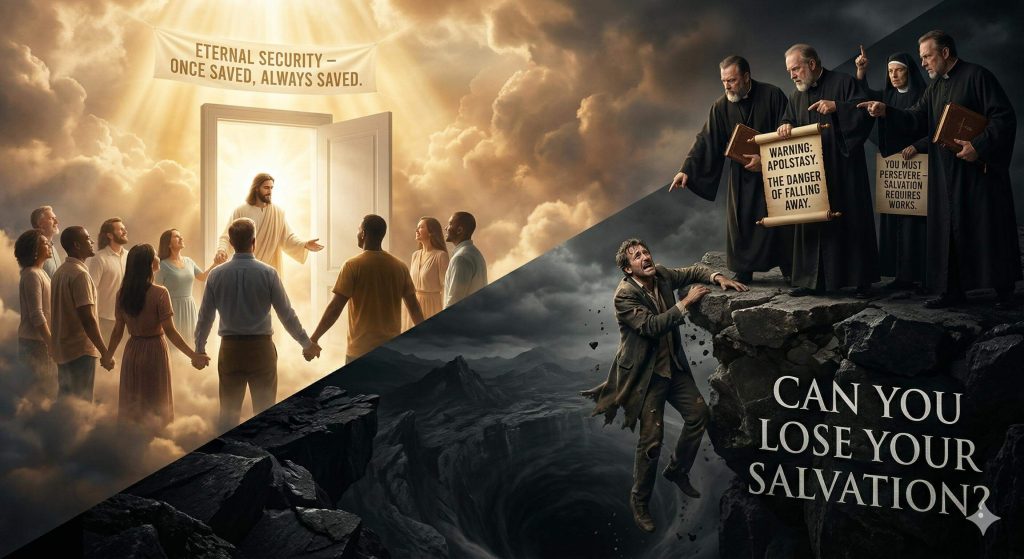
Can you Lose Your Salvation?
Here’s a question that has quietly tortured more believers than most pastors will admit: What if I’ve done too much?
What if I’ve gone too far? What if God is done with me? If you’ve ever lain awake wondering whether your sin has finally pushed God past His limit, this post is for you. And if you’ve never wrestled with this, read it anyway, because the answer will change the way you live far more than another sermon about trying harder ever could. In this post, we will explore Why You Cannot Lose Your Salvation.
Why So Many Christians Live in Constant Fear of Losing God’s Favour
The idea that salvation can be forfeited, that your standing before God rises and falls with your behaviour, is not a fringe teaching. It’s everywhere. It shows up in the quiet anxiety of believers who love God but never feel quite sure He loves them back. It shows up in the exhausting cycle of sin, guilt, recommitment, and repeat.
It shows up in the tragic spectacle of Christians who walk away from faith entirely, convinced they’ve finally crossed a line God won’t forgive. And the cruel irony? The fear of losing salvation often produces the very spiritual instability it claims to prevent. There has to be a better foundation than this.
The Myth That Keeps You Spiritually Paralysed
The most common argument for losing salvation goes something like this: God is holy, you are responsible, and if you walk away from Him or sin badly enough, or stop believing, He will let you go. It sounds reasonable. It even sounds reverent. But it rests on a fatal assumption: that your salvation is held in place, at least in part, by you.
Think about what that actually means. It means your eternal destiny is partially contingent on your performance. It means the cross was necessary but not quite sufficient. It means grace is a gift, but one you can return. That’s not New Covenant grace; that’s a hybrid. It is grace mixed with works, mercy mixed with merit.
Paul was not subtle about what he thought of that combination. He wrote:
“I do not set aside the grace of God; for if righteousness comes through the law, then Christ died in vain.” (Galatians 2:21)
If your continued salvation depends on your continued faithfulness, then the cross didn’t finish the job. Someone has to finish it for you. And according to the New Testament, Jesus already addressed that concern from the cross with a single word: tetelestai. It is finished.

Deepen your understanding: To truly live from this finished work, you must learn How to Stop Praying Like an Orphan and start communicating as a secure son.
What “Saved” Actually Means; and Why It Changes Everything
The Greek word sozo, typically translated “saved,” carries the weight of rescue, healing, preservation, and wholeness. Salvation in the New Testament is not a transaction you complete; it’s a life you enter. It’s not a certificate you can have revoked; it’s a birth you cannot un-happen.
Jesus didn’t use insurance policy language when He described eternal life. He used family language. He declared:
“My sheep hear My voice, and I know them, and they follow Me. And I give them eternal life, and they shall never perish; neither shall anyone snatch them out of My hand. My Father, who has given them to Me, is greater than all; and no one is able to snatch them out of My Father’s hand.” (John 10:27-29)

Notice the architecture of that promise. You are held by the Son. The Son is held by the Father. The Father is greater than all. The security is not in your grip on God; it’s in God’s grip on you. And if no one can snatch you out of His hand, the question worth asking is: does that include yourself? The text doesn’t carve out an exception. You are not the one exception to the promise.
So What Does This Actually Mean for the Way You Live?
Here’s what eternal security is not: it is not a blank cheque for reckless living. It is not permission to treat grace as a safety net you deliberately fall into. Paul anticipated this misreading immediately:
“What shall we say then? Shall we continue in sin that grace may abound? Certainly not!” (Romans 6:1-2)

But notice something important about Paul’s answer. He doesn’t say, “No, because then God will take your salvation away.” He says, “No, because that makes no sense. How shall we who died to sin live any longer in it?” The argument against sin is not fear of losing grace. It’s the sheer irrationality of returning to a prison you’ve already been released from. You’re not a slave anymore. Why would you go back to the slave quarters?
When you truly understand that you are unconditionally loved, permanently accepted, and eternally secured by the work of Another, it doesn’t produce apathy. It produces the only thing that actually changes behaviour: gratitude. You stop performing for God and start living from God. The motivation shifts from fear to love. And love is a far more powerful engine for transformation than terror.
FAQ: Understanding Your Eternal Security
Can habitual sin cause me to lose my salvation?
No. While sin is destructive and can damage your experience of life , your salvation is based on the Finished Work of Christ , not your ability to remain sinless.
What about the “warning” passages in the Bible?
Passages like Hebrews 6 or 2 Peter 2 are real warnings , but they often address those who had intellectual exposure without genuine Spirit-wrought transformation. They serve to keep believers from drifting rather than stating God revokes His life.
If I’m secure, why should I bother living holy?
Because holiness is your new nature. You don’t live holy to stay saved; you live holy because you are a New Creation. Understanding your identity is the key to overcoming sin naturally.
You Are More Secure Than You Think
The gospel is not good advice that you follow to stay in God’s good books. It is good news about what God has already done and secured on your behalf. Your salvation is anchored not in the steadiness of your faith, but in the faithfulness of your Saviour.
You will have doubts. You will fail. You will have seasons where you feel nothing. None of that moves you one millimetre out of His hand. The Scripture promises:
“Being confident of this very thing, that He who has begun a good work in you will complete it until the day of Jesus Christ.” (Philippians 1:6)
God is not a builder who runs out of funds halfway through. He finishes what He starts. The good work in you is His project, not yours. And He has a perfect completion record. The question was never whether you could hold on tight enough. The question is whether He can. And He already answered that, with nail-scarred hands that never let go.
That’s not a reason to sin more; it’s a reason to love more. And that, finally, is the whole point.
Next Steps for Your Journey:
- Study: Dive deeper into your new identity with the Created to Rule book.
- Listen: Discover How to Let the Holy Spirit Flow Through You Naturally as you rest in His grace.
- Grow: Join the School of the Prophet to activate the gifts God has placed within your secure spirit.


One Response
This really exposes how many believers are still relating to God from a place of fear rather than from the finished work of the cross. If salvation can be lost, then it was never truly a gift, and it ultimately becomes something we must maintain.
The shift from trusting in our consistency to trusting in Christ’s completeness changes everything. Security in Him doesn’t produce carelessness, but rest, confidence, and real transformation.